The Offshore Special Regulations 2026-2027 took effect on 1 January 2026, and a Version 2 takes over on 1 January 2027. The changes most likely to cost you money: every lifejacket must be a gas inflatable made after 2011 and serviced by an approved station (OSR 5.01), every EPIRB on a Category 0 to 2 boat must have internal GNSS from 2027 (OSR 4.19.3), storm and heavy weather sails face tighter specifications (OSR 4.27), and welded metal keels on Category 0 to 2 monohulls need non-destructive testing, with evidence required from 2030 (OSR 3.02).
Updated 21 September 2026.
World Sailing publishes the Offshore Special Regulations (OSR) every two years. The current edition covers January 2026 to December 2027. I compared the published 2026-2027 text line by line against the last 2024-2025 version (Version 1.15, 25 November 2025) and against World Sailing’s own “study” version, which marks every change. Everything below comes from those documents, with the rule number for each change.
One thing before the detail: the regulation itself is the authority, and your race’s Notice of Race can modify it. Read the World Sailing Offshore Special Regulations page and download the extract for your category before you spend money.
The two versions and their dates
- Version 1 is dated 5 December 2025 and has applied since 1 January 2026. It replaced the 2024-2025 edition.
- Version 2 is dated 5 June 2026 and applies from 1 January 2027. Its revision note cites two proposals: CO-2025-008, accepted by World Sailing’s Council in the first quarter of 2026, and OOC-2026-001, accepted at the Oceanic and Offshore Committee meeting on 26 May 2026.
Version 2 is a small update. Comparing the two texts, only 2 things change: the EPIRB rule in OSR 4.19.3 (covered below), and Appendix M, the optional Notice of Race wording, which is removed from the OSR and moved to World Sailing policy J5. Every other difference between the two PDFs is renumbering or layout.
How the categories work
The organising authority picks a category for each race under OSR 2.01, and may modify the OSR “to suit local conditions”. The category decides which rules apply to your boat.
| Category | Rule | What the OSR says it covers |
|---|---|---|
| 0 | 2.01.1 | Trans-oceanic races, including waters where air or sea temperature is likely below 5°C, with no expectation of outside help |
| 1 | 2.01.2 | Long-distance races well offshore, fully self-sufficient for extended periods |
| 2 | 2.01.3 | Extended races along or not far from shorelines, or in large unprotected bays or lakes |
| 3 | 2.01.4 | Races across open water, mostly relatively protected or close to shore |
| 4 | 2.01.5 | Short races close to shore in relatively warm or protected water, normally in daylight |
| Inshore | Appendix B | Short daylight races close to shore with shelter or rescue all along the course |
| Dinghy | Appendix C | Short daylight dinghy races with rescue boats along the course |
Every rule in the OSR carries a prefix showing where it applies. “Mo” means monohull, “Mu” means multihull, and the digits are categories. So “Mo0,1,2” applies to Category 0, 1 and 2 monohulls only, and “MoMu1,2” applies to both hull types in Categories 1 and 2. A “**” prefix means all boats in Categories 0 to 4. I quote these prefixes below because the monohull and multihull split matters for several changes.
Offshore Special Regulations 2026 changes that need a purchase or refit
This table covers the changes that can force you to buy, replace, test or service something. “Before” is the 2024-2025 edition (Version 1.15). “After” is 2026-2027 Version 1 unless marked Version 2.
| Rule | Applies to | Before (2024-2025) | After (2026-2027) | From |
|---|---|---|---|---|
| 5.01.1 Lifejacket | All boats, Cat 0 to 4 (**) | Lifejackets made before 2012 allowed if ISO 12402-3 (Level 150) or equivalent, including EN 396 or UL 1180 | Gas inflatable, ISO 12402-3 (Level 150), manufactured after 2011 | 1 Jan 2026 |
| 5.01.4 Lifejacket check | All boats, Cat 0 to 4 (**) | Person in charge checks each lifejacket once a year | Each lifejacket serviced to the maker’s recommendation by an approved service station, next service date not exceeded | 1 Jan 2026 |
| 4.19.3 EPIRB | MoMu0,1,2 | EPIRB registered after 2015 needs internal GPS | V1: EPIRB registered after 2026 needs internal GNSS and AIS transmit. V2: every 406 MHz EPIRB needs internal GNSS; AIS transmit if registered after 2026 | V1 1 Jan 2026; V2 1 Jan 2027 |
| 3.02.2 b), 3.02.3 b) Keel NDT | Mo0,1,2 | No testing requirement | Welded metal keels examined by non-destructive testing by an independent qualified person; evidence within 10 years of the start or after a grounding | Evidence required from 2030 |
| 3.02.2 a) Structural inspection | Mo0,1,2 | “A qualified person”, externally, boat out of the water | “An independent qualified person”, boat out of the water | 1 Jan 2026 |
| 3.04.1 note b Stability | Mo0,1 | Designer’s declaration or CE mark | Compliance confirmed by measured displacement and an inclining test | “From 2027” |
| 4.02.3 Inverted visibility | Mo0,1 added; Mu0 to 4 already | Multihulls only | 1 m² of highly visible pink, orange or yellow showing when the boat is inverted | Mo0,1 from 2027 |
| 4.07 Lights | Mo0,1,2,3 and Mu0 to 4 | 400 lumens only on the rechargeable LED alternative | Every flashlight and searchlight IP67, at least 400 lumens | 1 Jan 2026 |
| 3.29.1 Handheld VHF | Mo1,2,3 and Mu1,2,3,4 | No minimum power | Minimum 5 W output | 1 Jan 2026 |
| 3.29.6 g), h) Cockpit speaker | MoMu1,2; MoMu3 with fewer than 3 crew | Not required | External speaker in the cockpit for the fixed VHF | 1 Jan 2026 |
| 4.27.2 Storm trysail | MoMu0,1,2,3 | Area formula applied to sails made after 2011 | Formula applies to every trysail; designed for Beaufort 8 on all points of sail | 1 Jan 2026 |
| 4.27.3 Heavy weather jib | Where 4.26 requires one | Area “of 13.5%” of foretriangle height squared; formula for post-2011 sails | Area “not greater than” 13.5%; formula for all sails; designed for Beaufort 6 | 1 Jan 2026 |
| 4.27.4 Storm jib | MoMu0,1,2 | Area of 5%, maximum luff 65%; formula for post-2011 sails | Area and luff “not greater than” those limits; formula for all sails; no battens; designed for Beaufort 8 | 1 Jan 2026 |
| Appendix B, 5.01.1 | Inshore racing | PFD with whistle, at least 150N, unless class rules or SIs say otherwise | Gas inflatable, ISO 12402-3 (Level 150), manufactured after 2011, plus 5.01.4 servicing | 1 Jan 2026 |
| Appendix C | Inshore dinghy racing | PFD to ISO 12402-5 Level 50 “or equivalent” | Buoyancy aid to ISO 12402-5 (Level 50), manufactured after 2006, correct size range | 1 Jan 2026 |
Lifejackets: the change that reaches the most people (OSR 5.01)
OSR 5.01.1 now reads: “A gas inflatable lifejacket which shall comply with ISO 12402-3 (Level 150) and have been manufactured after 2011.” It carries the “**” prefix, so it applies to every crewmember in Categories 0 to 4. The old route for pre-2012 jackets built to “equivalent” standards such as EN 396 or UL 1180 is gone.
The fitted items must each comply with ISO 12402-3 or ISO 12402-8. In the Category 1 extract they are:
- a) a manual or automatic gas inflation system (all categories)
- b) a ride up prevention system, meaning a crotch strap or thigh straps (all categories)
- c) an emergency position indicating light (MoMu0,1,2,3)
- d) a sprayhood (MoMu0,1,2,3)
- e) a deck safety harness attachment (MoMu0,1,2)
- f) a personal location device, which appears only in the Category 0 extract
The jacket must also be in the right size range for the wearer, as marked on it (item g), and be indelibly marked with the owner’s or boat’s name (item h). The old rule allowed the light to meet the LSA Code as an alternative to ISO 12402-8; that option is no longer listed.
OSR 5.01.4 changes the annual check. The person in charge must now confirm each lifejacket “has been serviced in accordance with the manufacturer’s recommendation by an approved service station” and that the next service date marked on it has not passed. If you have always serviced your own jackets, budget for station servicing. OSR 5.01.2 (a spare cylinder and, if needed, a spare activation head for each type on board) and 5.01.3 (one spare lifejacket, Categories 0 to 2) continue.
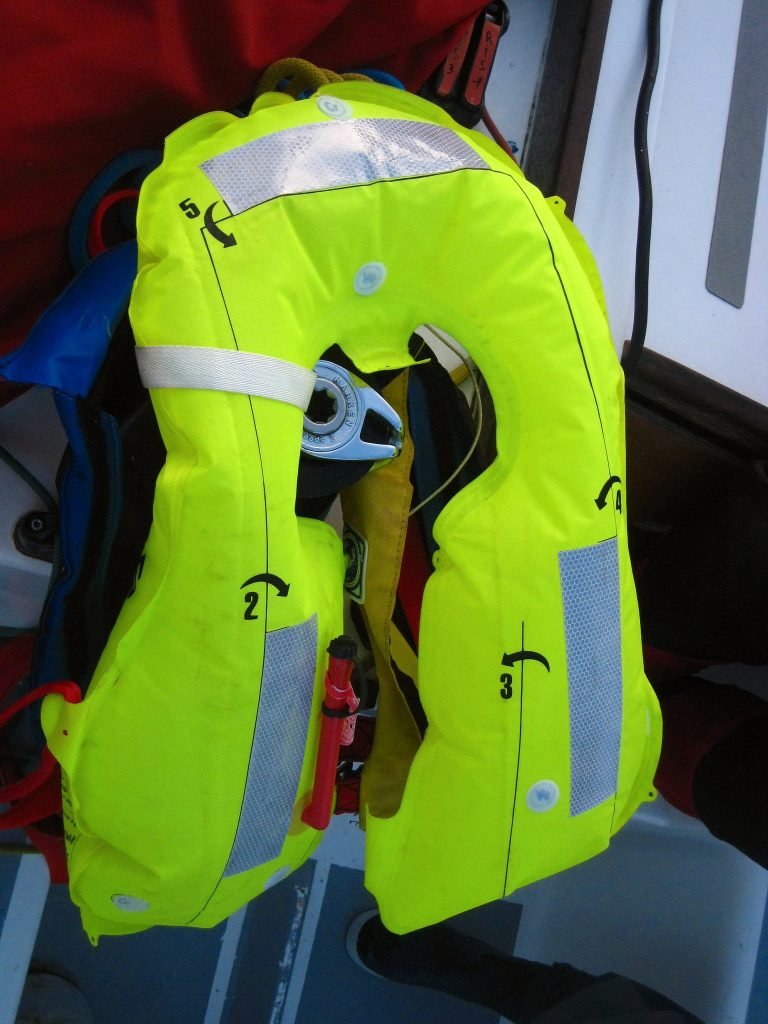
Club racers should read Appendix B. Inshore racing used to need only a personal flotation device with a whistle and at least 150N of buoyancy. Appendix B now repeats OSR 5.01.1 items a), b), g) and h) plus the 5.01.4 servicing rule. A foam buoyancy aid does not meet that text. Class rules and sailing instructions often set their own requirement for inshore events, so check what your club’s documents say before buying.
Appendix C, for dinghies, now requires a buoyancy aid to ISO 12402-5 (Level 50) manufactured after 2006 and in the correct size range. The words “or equivalent” have been removed.
EPIRBs: a second change arrives in January 2027 (OSR 4.19.3)
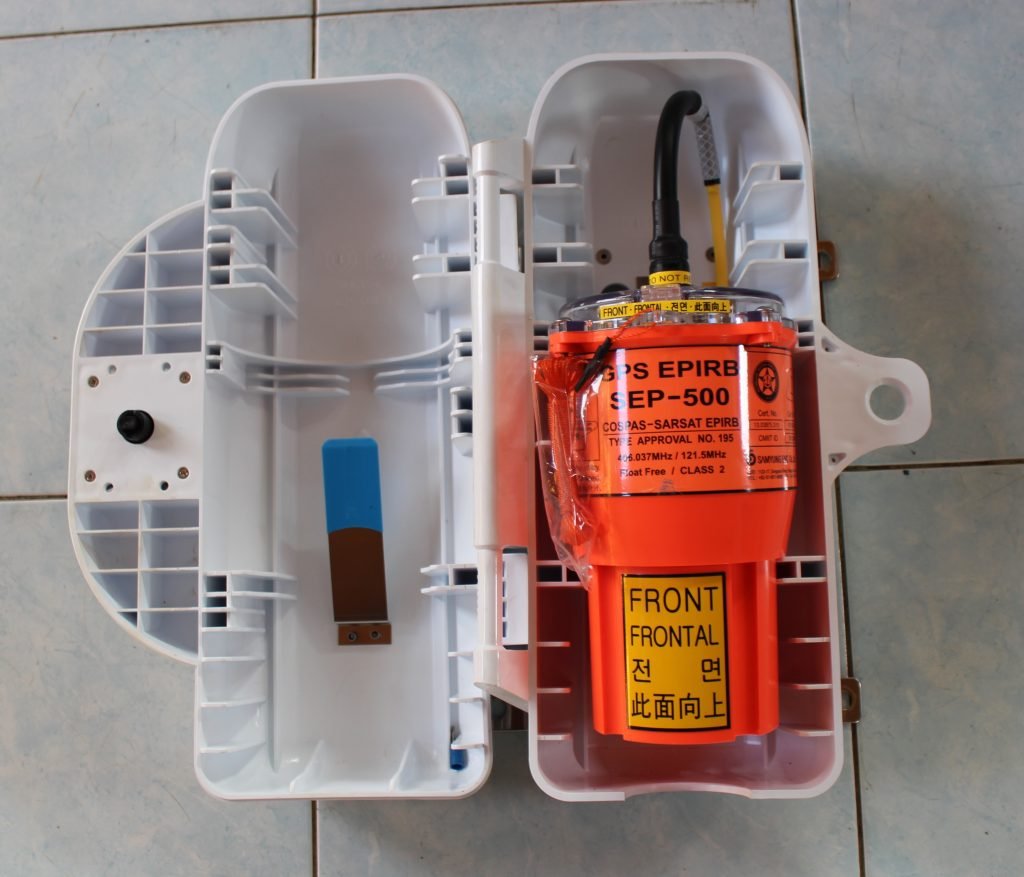
Category 0 boats need two water and manually activated 406 MHz EPIRBs (OSR 4.19.1). Category 1 and 2 boats need one (OSR 4.19.2). The wording of 4.19.3, which applies to MoMu0,1,2, changed on 1 January 2026 and changes again on 1 January 2027:
- 2024-2025: “A 406 MHz EPIRB registered after 2015 shall include an internal GPS.”
- 2026-2027 Version 1: “A 406 MHz EPIRB registered after 2026 shall include an internal GNSS and the ability to transmit AIS.”
- 2026-2027 Version 2, from 1 January 2027: “A 406 MHz EPIRB shall include an internal GNSS. If registered after 2026 it shall have the ability to transmit AIS.”
The practical effect of Version 2 is that registration date no longer protects an older beacon. From 1 January 2027, any EPIRB on a Category 0, 1 or 2 boat without internal satellite positioning fails 4.19.3, however old it is. A beacon registered in 2027 or later must also transmit AIS. An EPIRB with internal GPS already registered before 2027 still complies without AIS.
OSR 4.19.4 is unchanged: every EPIRB must be registered with the authority for the country code in its 15-character hex ID, or directly in the Cospas-Sarsat IBRD where that country allows it.
Keel and rudder inspection (OSR 3.02 and Appendix L)
These rules apply to Category 0, 1 and 2 monohulls (Mo0,1,2). Multihulls are not included.
OSR 3.02.2 a) now requires the structural inspection to be done by “an independent qualified person with the boat out of the water”. The old text said “a qualified person externally”. The rule adds a pointer to ISO 12215-9 clause B.5 for keel bolt checks where the owner’s manual says nothing. OSR 3.02.3 a) keeps the timing: evidence of an inspection within 24 months before the start, or after a grounding, whichever is later. Whether “independent” rules out an owner’s own yard or rigger is a question for your organising authority; the OSR does not define it further.
OSR 3.02.2 b) is new. Welded metal keels “shall be examined by an independent qualified person using non-destructive testing techniques (such as dye penetrant, ultra-sonic, X-ray and other methods)”. Under OSR 3.02.3 b), “From 2030”, you need evidence of that testing within 10 years before the start of the race or after a grounding, whichever is later. Appendix L adds that the evidence must be a document signed by someone representing the organisation that did the tests.
The date matters for planning. A test done in 2026 would still be inside the 10-year window in 2030, so owners who are hauling out anyway can do it now and keep the signed report.
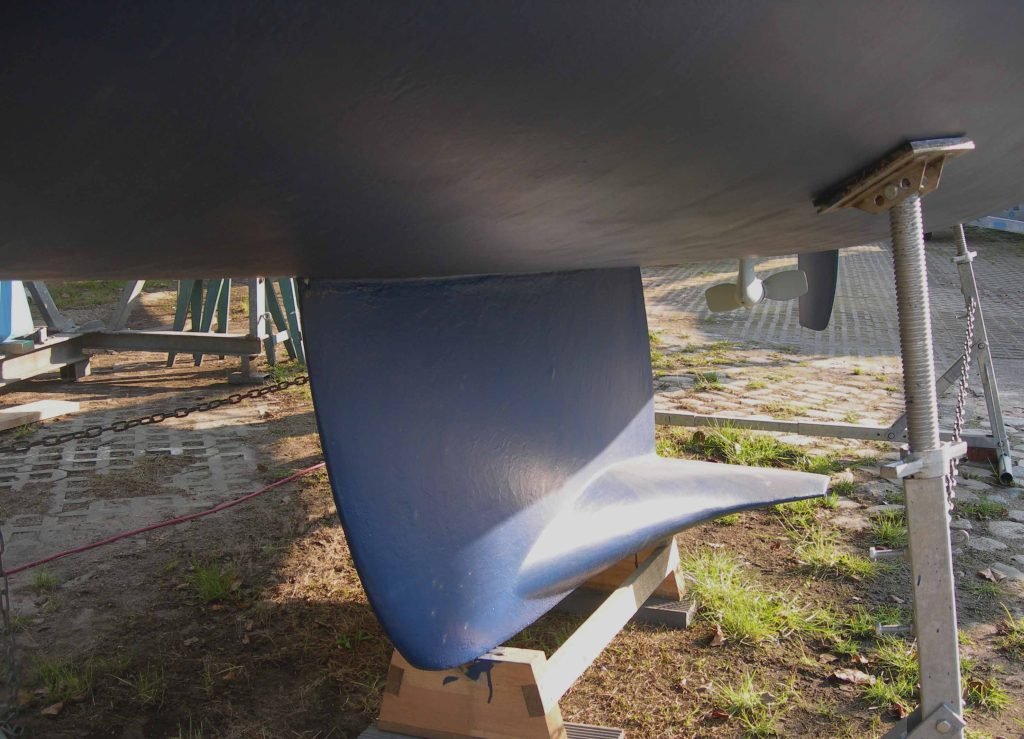
For Category 3 monohulls, OSR 3.02.4 is unchanged: the owner or a representative inspects the keel and rudder at a haul-out within 2 years before the event, following Appendix L. OSR 3.02.5 still requires an internal and external inspection by an appropriately qualified person after any unintentional grounding (Mo0,1,2,3).
Appendix L itself was rewritten. The model procedure now names canting keels alongside lifting and swing keels, tells inspectors to check keel fasteners for corrosion and bolt holes for deformation, and points to ISO 12215-9 clause B.5 for bolt torque when there is no owner’s manual.
Hull construction and stability (OSR 3.03 and 3.04)
OSR 3.03.1 a) covers Category 0 to 2 monohulls with a series date after 2009 and under 24 m LH. These boats may now meet 3.03.1 b), the Classification Society route used for boats of 24 m and over, or the ISO 12215 Category A route. The ISO route is now split into three parts: designed and built to ISO 12215 Category A, maintained so it would still meet Category A, and a World Sailing plan review certificate. That restructure does not add equipment, though the “maintained” test is now its own sub-clause.
OSR 3.04.1 changes more for Category 0 and 1 monohulls. They must comply with ISO 12217-2 design category A. If they cannot, the rule lets them fall back only on “OSR 3.04.2b or OSR 3.04.3b”. The IRC SSS route (OSR 3.04.4) is no longer offered to them, though Category 2 monohulls keep all three fallbacks. A footnote applying to Mo0,1 then says: “From 2027, this compliance shall be confirmed by having the actual displacement measured and by an inclining test.” If you race Category 0 or 1 and have never had an inclining test, ask your organising authority now how they will apply this. I read the published text as requiring one, but the cross-references to “3.04.2b” and “3.04.3b” are not laid out clearly in the PDF.
Communications and lights (OSR 3.29 and 4.07)
The OSR now says GNSS where it used to say GPS, in the 3.29 heading, 3.29.6 f), 3.29.8 and the crew overboard position rule in 4.22.2. GPS is one GNSS system, so a working GPS receiver still meets the wording and nothing here forces a new plotter.
- OSR 3.29.1 (Mo1,2,3 and Mu1,2,3,4): the handheld VHF in each grab bag must now have “minimum 5 W output power”. Older 1 W or 3 W sets no longer qualify.
- OSR 3.29.6 g) (MoMu1,2): the fixed VHF must “have an external speaker in the cockpit”.
- OSR 3.29.6 h) (MoMu3): the same speaker is required “if the number of crewmembers is fewer than 3”.
- OSR 4.07 (Mo0,1,2,3 and Mu0 to 4): every flashlight and searchlight must be watertight to at least IP67, have spare batteries or be rechargeable, have spare bulbs or be LED, and “provide at least 400 Lumens”. Before, the 400-lumen figure applied only to the rechargeable LED alternative. A new item c) says that on boats with only two crew, the searchlight must be reachable from the cockpit without going below.
OSR 4.02.3, the 1 m² patch of pink, orange or yellow visible when the boat is upside down, used to apply to multihulls only. It now reads “From 2027 (for Mo0,1)”, which brings Category 0 and 1 monohulls in from next year. Multihulls in all categories already had to comply.
Storm and heavy weather sails (OSR 4.27)
The inventory rule, OSR 4.26, is renumbered but asks for the same sails: a storm trysail for Category 0 (4.26.1), a trysail or 50% reefing for Categories 1 and 2 (4.26.2), a trysail or 40% reefing for Category 3 (4.26.3), 12.5% reefing or a heavy weather jib for Category 4 (4.26.4), a heavy weather jib for Categories 0 to 3 (4.26.5) and a storm jib for Categories 0 to 2 (4.26.6).
The specifications in OSR 4.27 changed in ways a sailmaker will care about:
- The pre-2012 exemption is gone. The area formulas used to apply “for sails made after 2011”. They now apply to every storm trysail (4.27.2 b), heavy weather jib (4.27.3 b) and storm jib (4.27.4 c). An older sail that was never measured this way may now be oversize.
- Areas are now maximums. The heavy weather jib is “not greater than 13.5%” of foretriangle height squared, where it used to be “of 13.5%”. The storm jib is “not greater than 5%”, with luff length “not greater than 65%” of foretriangle height.
- Storm jibs must have no battens (4.27.4 e). This is new for the storm jib; the trysail rule already banned them.
- Design wind strength moved into each sail’s specification. The trysail and storm jib must be designed for propulsion and steerage in Beaufort 8 on all points of sail (4.27.2 g, 4.27.4 f); the heavy weather jib for Beaufort 6 (4.27.3 d).
- The old 4.27.1 e), which capped area at the lesser of the rule or the designer’s or sailmaker’s figure, has been deleted.
Unchanged in 4.27.1: storm sails bought after 2013 must be a highly visible colour, aramid and carbon are banned in trysails and storm jibs (HMPE is allowed), and every storm and heavy weather sail needs its own deck sheeting position, with the trysail sheeted independent of the boom.
Who this affects beyond racers
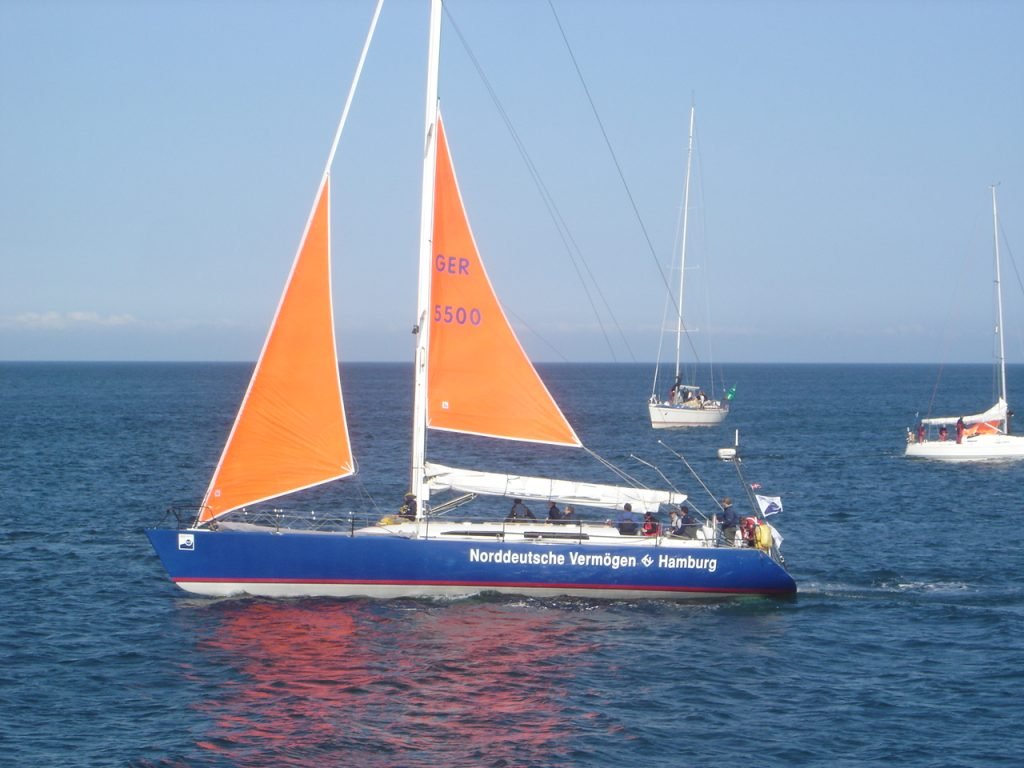
Organising authorities choose which OSR category to apply, and some events outside mainstream racing use it. The ARC 2025 Racing Division Notice of Race lists “World Sailing Offshore Special Regulations for Category I (2024-2025)” under clause 1.2.1. World Cruising Club’s safety equipment page says its rally requirements are “based on” the OSR, so its own list is the document that governs cruising entries. Expect rally organisers to move their references to the 2026-2027 edition over time; check the current year’s documents.
Insurance is harder to pin down. The Pacific Cup’s insurance guidance tells entrants to describe their boat to underwriters as meeting the Special Regulations. I could not find a published insurer policy wording that names the OSR as a condition, so ask your own insurer whether your racing or passage cover refers to it.
Club racers are covered too, through Appendix B (inshore keelboats) and Appendix C (dinghies), where your club’s sailing instructions adopt them.
What to check on your boat now
- Find out which category and which OSR version your next event uses. Version 2 applies from 1 January 2027, but the Notice of Race decides which edition, and which modifications, your event uses.
- Read the manufacture date on every lifejacket aboard. Anything made in 2011 or earlier, or any foam jacket, fails OSR 5.01.1.
- Check each lifejacket’s next service date, and book approved station servicing where it is due (OSR 5.01.4).
- Confirm your EPIRB has internal GNSS. Category 0 to 2 boats need it on every beacon from 1 January 2027 (OSR 4.19.3, Version 2). Check its registration is current (OSR 4.19.4).
- Check the output of each grab bag handheld VHF is at least 5 W (OSR 3.29.1) and that you have a cockpit speaker if 3.29.6 g) or h) applies.
- Check the lumen rating and IP67 rating of every flashlight and searchlight (OSR 4.07).
- Ask your sailmaker to measure the trysail, heavy weather jib and storm jib against the OSR 4.27 formulas, and remove any battens from the storm jib.
- If you sail a Category 0 to 2 monohull, confirm your last structural inspection is inside 24 months and was done by an independent qualified person (OSR 3.02.2 a, 3.02.3 a). If the keel is welded metal, plan non-destructive testing before 2030 (OSR 3.02.2 b, 3.02.3 b).
- If you sail a Category 0 or 1 monohull, ask your organising authority how it will apply the 2027 inclining test note in OSR 3.04.1, and plan a 1 m² high-visibility patch that shows when inverted (OSR 4.02.3).
World Sailing publishes category extracts with an inspection card (Appendix F) for each one on the OSR page, alongside the full Version 1 PDF and the Version 2 PDF effective 1 January 2027. Working through the card for your category is the fastest way to find gaps. Where this summary and the published regulation differ, the regulation wins.